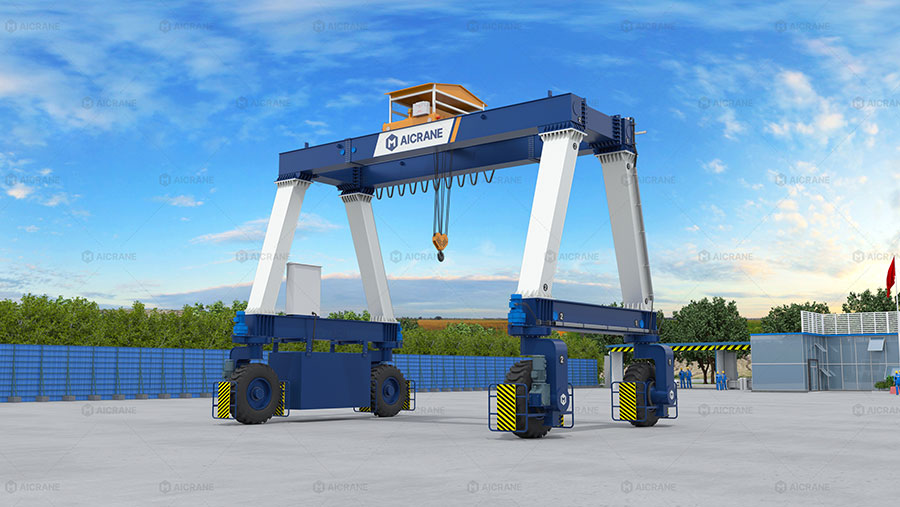
Rubber tyred gantry cranes (RTGs) are among the most flexible and efficient material-handling solutions used in container terminals, logistics yards, manufacturing sites, steel yards, and precast concrete plants. Unlike rail-mounted gantry cranes (RMGs), which operate on fixed tracks, RTG cranes offer exceptional mobility, making them ideal for operations where multiple work zones, changing layouts, or high flexibility requirements exist. But what exactly determines the mobility of a rubber tyred gantry crane? Mobility is not a single factor – it is the result of a combination of mechanical systems, structural design, control technologies, and environmental conditions working together.
This article explores the key factors that determine the mobility of a rubber tyred gantry crane for sale and how each aspect influences performance, maneuverability, operating efficiency, and yard safety.

1. Steering System Design: The Core of RTG Mobility
The steering mechanism is the most critical component influencing RTG mobility. Modern rubber tyred gantry cranes are equipped with multi-mode steering systems that enable operation in several directions and configurations. The precision and flexibility of these steering modes directly dictate how the crane moves within confined spaces.
1.1 Common Steering Modes
RTGs typically include several steering options:
-
Straight-line steering: Used for long-distance travel across container blocks or work zones.
-
Crab steering mode: Allows the crane to move diagonally, enabling flexible positioning without shifting orientation.
-
All-wheel steering: Improves turning radius and enables smoother directional changes.
-
90-degree steering: Enables the crane to move sideward at a right angle, crucial for repositioning in tight yards.
-
Pivot or zero-radius steering: Allows the mobile gantry crane to turn within its own footprint.
Each of these modes enhances the crane’s ability to position itself quickly and efficiently. The more advanced and responsive the steering system, the higher the crane’s overall mobility.
1.2 Steering System Controls
Hydraulic or electric wheel steering systems determine how reliably and precisely the crane responds to operator input.
Electric wheel steering – common in newer designs – offers:
-
Better synchronization between wheels
-
Reduced maintenance
-
Higher steering accuracy
-
Smoother transitions between modes
A modern RTG’s steering control module also integrates with sensors to maintain wheel alignment and prevent oversteering, further enhancing its maneuverability.
2. Wheel Configuration and Tire Specifications
Rubber tires are what physically enable an RTG to move, and their design significantly affects rubber wheeled gantry crane mobility.
2.1 Number and Arrangement of Wheels
A typical RTG has 8, 16, or 32 wheels, depending on capacity, span, and manufacturer. More wheels increase load distribution and stability but require a more advanced steering system to maintain precise movement.
2.2 Tire Material and Quality
RTG tires must withstand:
-
High static loads (hundreds of tons)
-
Continuous directional changes
-
Abrasive operational surfaces
-
Heavy cyclic stresses
High-quality natural rubber compounds perform better on rough surfaces and provide improved traction, which directly impacts mobility, especially under wet or dusty yard conditions.
2.3 Tire Maintenance
Well-maintained tires reduce rolling resistance, improve traction, and ensure smoother movement. Poor maintenance—uneven wear, low pressure, or damage—reduces mobility, increases fuel consumption, and affects steering accuracy.
3. Drive and Power Systems
The method by which an RTG is powered and driven plays an important role in its mobility characteristics.
3.1 Diesel RTGs
These traditional cranes rely on diesel engines:
-
High torque for strong traction
-
Suitable for heavy-duty movement
-
Flexible for yards without electrical infrastructure
However, diesel engines may generate slower acceleration, higher vibration, and reduced control precision compared to fully electric alternatives.
3.2 Fully Electric RTGs (E-RTGs)
Electric wheel motor drive systems significantly enhance mobility, offering:
-
Smooth acceleration
-
Instant torque response
-
More precise wheel control
-
Reduced noise and vibration
-
Lower maintenance on mechanical components
These cranes are also compatible with yard automation technologies, further increasing mobility efficiency.
3.3 Hybrid and Battery RTGs
Hybrid power systems improve movement performance by supplying steady, consistent power. Battery-driven or hybrid systems reduce fluctuations in torque output, making steering and directional changes smoother.
4. Weight Distribution and Structural Design
A rubber tyred gantry crane’s structure directly influences how easily it can move. The overall mobility depends on balanced load distribution across all wheels and on the stability of the gantry frame during movement.
4.1 Critical Structural Factors
-
Gantry height and span: Large gantry cranes require more powerful drive systems for smooth movement.
-
Trolley weight: Heavier trolleys increase inertia during movement.
-
Hoist load position: Load sway and off-center loads affect maneuverability.
A well-designed RTG ensures that weight is evenly distributed across the tire groups to prevent excessive pressure on individual wheels, which could hinder movement or cause wheel slip.
5. Control Technologies and Intelligent Assistance
Advanced control systems significantly enhance RTG mobility by improving navigation accuracy and reducing operator errors.
5.1 Sensors and Positioning Systems
Modern RTGs incorporate:
-
GPS / RTK systems
-
Anti-collision radars
-
Position reference sensors
-
Load sway control sensors
These systems help maintain precise movement and positioning even in complex or crowded work environments.
5.2 Anti-Sway Technology
Anti-sway systems keep the load stable during crane movement. Minimizing sway enables the crane to travel faster, especially when transporting heavy or fragile cargo. This directly increases operational mobility and overall efficiency.
5.3 Remote and Semi-Automated Control
Remote operation allows the crane to be maneuvered with better visibility, while automation helps optimize steering mode transitions. Both technologies contribute to safer and faster crane movement.
6. Yard Conditions and External Factors
Environmental and ground conditions also influence RTG mobility.
6.1 Surface Flatness
Uneven surfaces increase rolling resistance and reduce maneuverability. RTGs can operate on slightly uneven asphalt or concrete, but extreme unevenness can:
-
Slow movement
-
Increase tire wear
-
Affect steering control
6.2 Traction Conditions
Dusty, wet, or oily surfaces reduce tire grip, affecting the crane’s ability to maneuver. Good yard maintenance is therefore essential.
6.3 Operational Layout
Cramped or poorly designed yard layouts require more advanced steering systems and highly skilled operators. RTGs with multi-mode steering are better suited for such operating environments.
Conclusion: Mobility Is the Integrated Result of Design, Technology, and Environment
The mobility of a rubber tyred gantry crane is determined by a combination of engineering, power systems, tire configuration, intelligent control technologies, and yard conditions. Steering systems form the core of mobility performance, but every factor—from tire maintenance to the power source—plays a significant role.
High-mobility RTGs deliver substantial operational benefits:
-
Faster repositioning between yard blocks
-
Higher yard productivity
-
Reduced downtime
-
Better adaptability to changing layouts
-
Lower operational costs
-
Improved safety
As ports, container yards, and industrial facilities continue seeking flexible and efficient handling equipment, RTG mobility will remain a key area of innovation and competitive advantage.